

How To Install Blender 2.81
Blender's development is very fast lately. It is simply a couple of weeks since we celebrated the release of Blender ii.80 and now there is already Blender 2.81 alpha available for download. and information technology is packed with new features. Some are improving the workflow (like Outliner improvements), some are improving modeling (VDB remesher works like magic) , but the one is really interesting, when it comes to rendering performance. Blender now is equipped with "Denoise" node that is based on Intel Open up Image Denoise.
Remove the racket
Intel Open Image Denoise is an open up source library of high-functioning, high-quality denoising filters for images rendered with ray tracing. At the heart of the Open Image Denoise library is an efficient deep learning based denoising filter, which was trained to handle a broad range of samples per pixel (spp), from 1 spp to almost fully converged. Thus it is suitable for both preview and final-frame rendering.
Information technology is not the kickoff denoiser in Blender. Blender has already born denoiser from a longer fourth dimension. It gets the job done, but it uses CPU for denoising, which tin be a bit wearisome.
If information technology would not be enough, this year Remingoton Pro released an add-on for Blender called D-Dissonance. Information technology is a side by side-gen AI denoising platform that rapidly accelerates the process of rendering noise-free images in Blender. Powered by NVIDIA's new OptiX AI-Accelerated Denoiser.
Then, now nosotros have three denoisers for Blender, two built-in and 1 as an add-on. Today I volition focus on the most contempo ane - Intel Open Epitome Denoiser.
Scene for testing
It'southward a Evermotion Archinteriors vol. 48 for Blender scene 1 rendered with CPU. We used 64 squared samples and built-in denoiser. What it means that samples were squared?
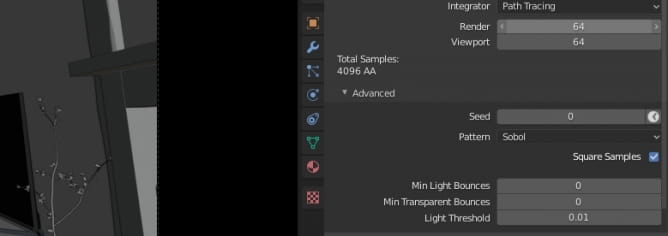
Blender allows us to tick a checkbox "square samples" for designating final sample count. When we employ "64" every bit a base, we become 64 ten 64 = 4096 samples total. From now on I volition refer to this number, instead of squared samples. This return made with CPU rendering takes literally hours on mid-range CPU. We need to render faster. Maybe we will use GPU?
GPU and retentiveness
Modern GPUs give a big heave to rendering speeds when information technology comes to path tracing. At first I thought that my RTX 2080 Ti will not take enough retention for rendering such a scene, just luckily, cycles tin return out-of-core memory - information technology can sum up arrangement and VRAM and use it for rendering. My 2080 Ti is equipped with 11 GB of VRAM, my system has 16 GB of RAM. The scene requires 13,9 GB of RAM to render. And so I am covered by a large extend.
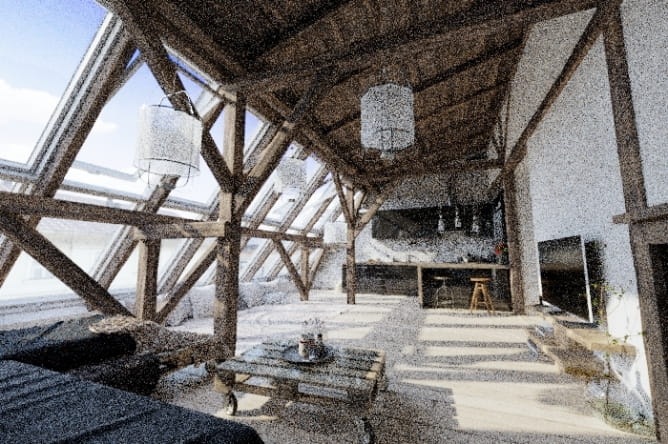
Examination number one. I rendered this scene with only 64 samples, denoising is off. I used GPU for rendering. Although the output is bad even for a preview, we proceeds the speed: my PC used about two min 20 sec for loading all assets and textures to retention and 22 seconds to return it. two:42 total. Mind that I reduced final resolution to l% and the output image is 700 x 465 px.
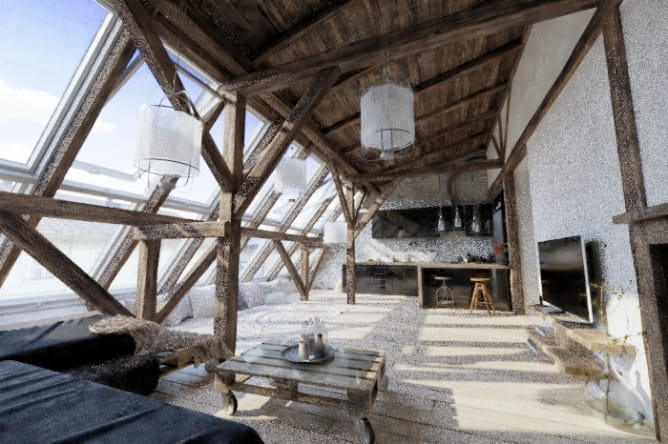
Then I turned on built-in denoiser. Unfortunately, the result paradigm is still noisy as hell - congenital in denoiser was not able to get rid of hundreds of fireflies and speckles, particularly on the correct wall. Let's cheque Intel Open Image Denoiser. We add it by uinserting "Denoise" node in Blender's Compositing editor.
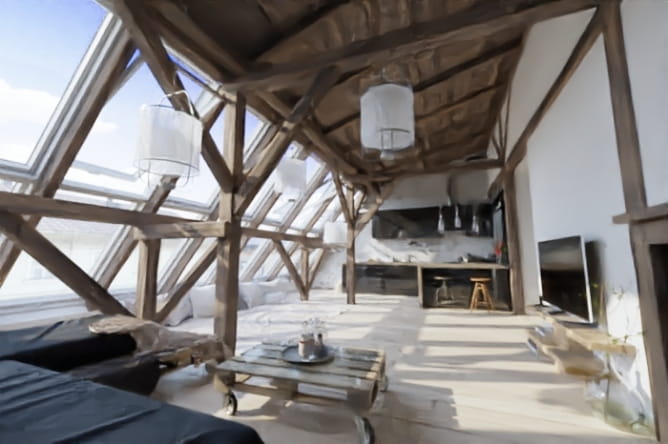
Well, the noise is gone, but the consequence is rather... creative! Everything is smudged and blurred. Ok, we used only 64 samples and rendering took literally seconds but perhaps we can get it better? In fact, we tin can!
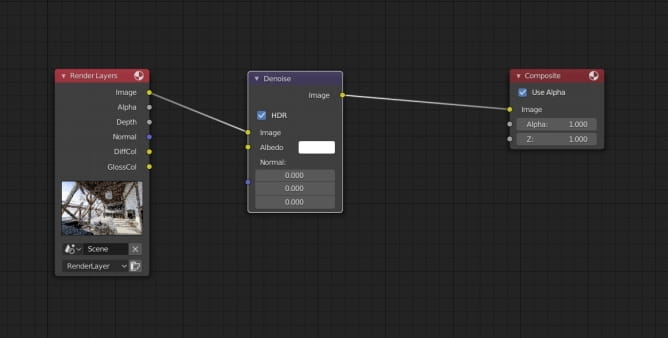
Intel Open Paradigm Denoiser can utilise rendered paradigm every bit a source for AI denoising. nosotros but need to add together "Denoise" node in Blender Compositing editor and connect it with image and output. But Intel'south denoiser can use more data - nosotros take also "Albedo" and "Normal" inputs. And then, what happens if we provide more information for denoiser?
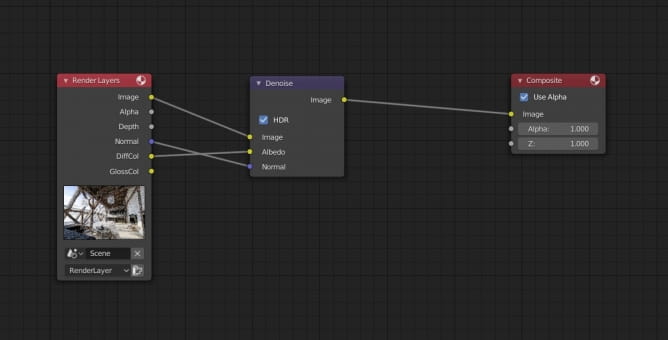
First, we need to connect dots...
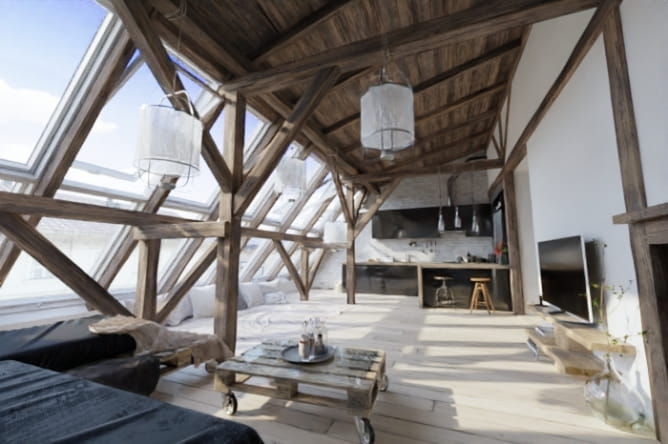
And the consequence is... amazing! We nonetheless get this "dreamy-denoised" look but this image is quite usable now! And nosotros only used 64 samples! Let's increment the resolution.
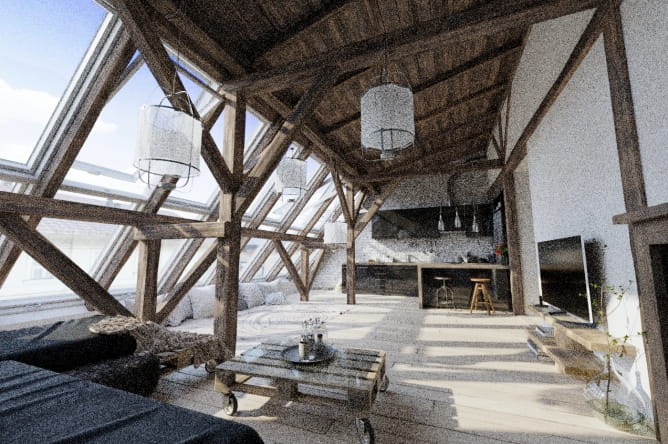
No denoising, full resolution (1400 x 933)
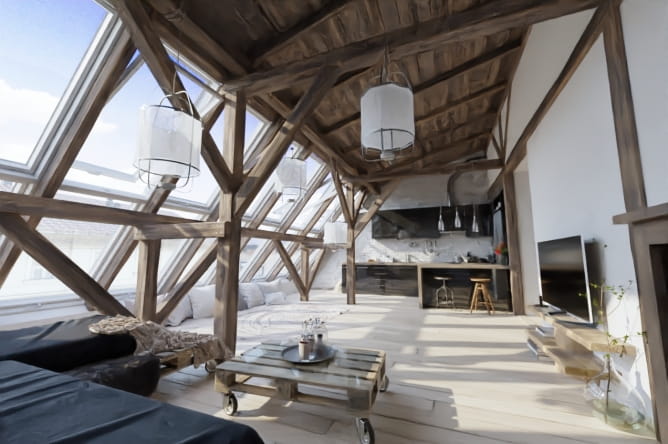
Simple Intel denoising (using only "Paradigm" input)
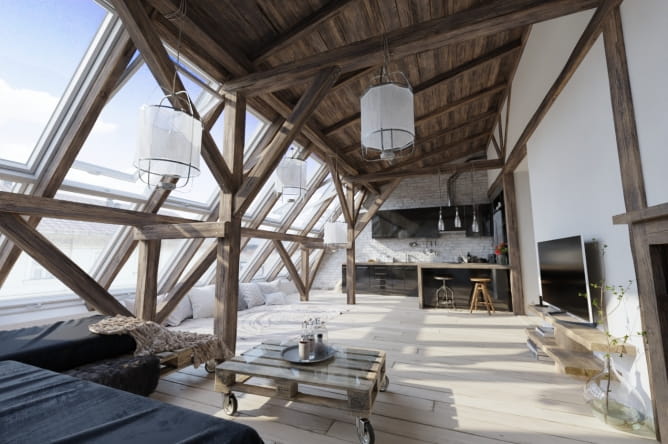
Full Intel denoising - using "Image", "albedo" and "Normal" inputs. Return time is all the same very brusque: 3:30 (caching: 2:23) At present, let's raise the number of samples!
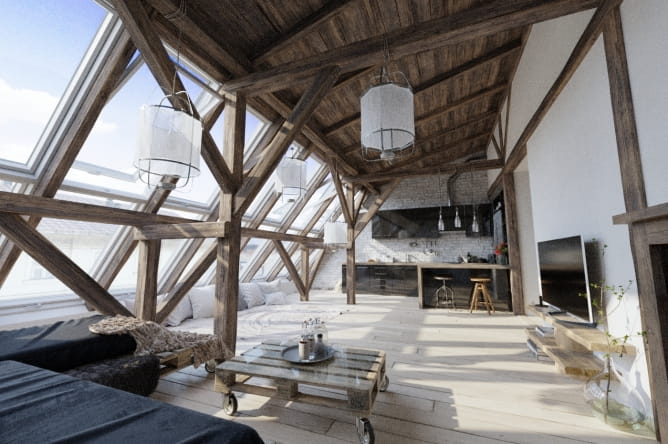
800 samples rendered with GPU, no denoising, 11 min and 57 sec
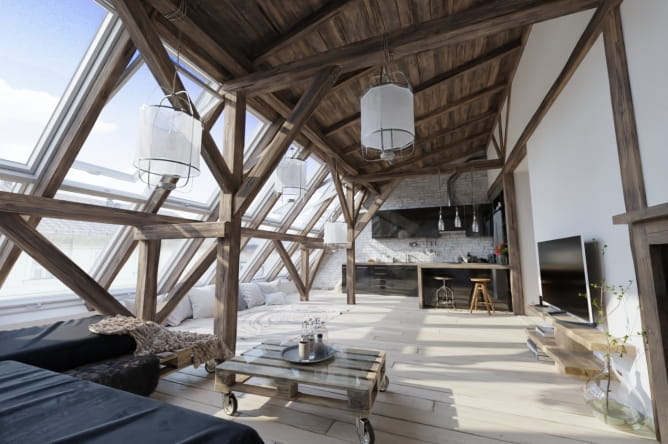
Simple Intel denoising - it looks ok, but all the same we get some smudging.
Full Intel denoising. I would say that this image is shut to production quality. And nosotros simply saved about an hour of render fourth dimension!
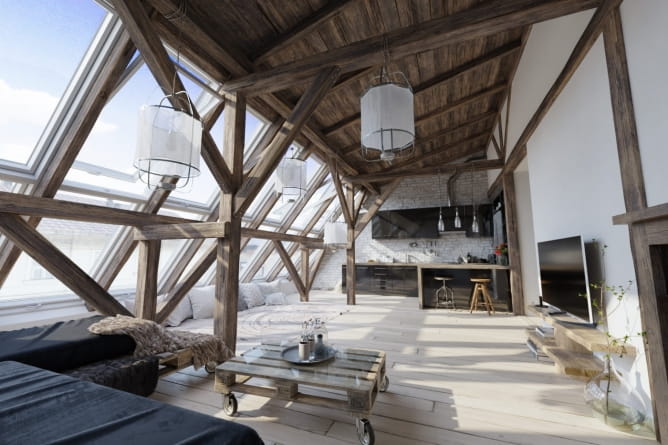
CPU rendering (4096 samples). >3 hours on 4770k, about an hr with GPU RTX 2080 Ti.
Summary
Intel Open Image Denoiser is just pure awesomness. It gives stunning results even with farthermost low sample counts. Information technology has cleaned this particular scene quickly and efficiently. We demand more than testing in unlike scenarios, but for a first I would say that it is extreme useful addition for Blender. And with upcoming RTX speed improvements and adaptive sampling we can say that Blender Cycles rendering will get rocket fast in non so afar future.
Cheers for reading!

Source: https://evermotion.org/tutorials/show/11601/new-intel-open-image-denoiser-in-blender-2-81
Posted by: rojastingettere.blogspot.com
0 Response to "How To Install Blender 2.81"
Post a Comment