

How To Repair Old Stone Walls
Acquire the fine art of dry stone walling…
Edifice with dry stone is one of the earliest skills developed past humans. Dry stone walls are durable because they comprise no mortar, but are held together by the weight of stone, and by the skill of the builder who selected and fitted the stones together.
Dry stone walling involves either stripping and rebuilding existing walls that have fallen into disrepair, or gapping – repairing gaps where the wall has collapsed. Fewer new walls are congenital, although foundations sometimes have to be relaid.
Let's look at the techniques.
Easily-on techniques for building a dry rock wall
Stripping out
Sort out the coping stones from the collapsed wall showtime and identify them two to three metres from the wall.
Take out the main stones and put the acme ones furthest from the wall. Keep the largest ones nearest the wall to aid building. Leave a gap of about 60cm alongside the wall for working. Go on throughstones safety and separate.
When stripping out a gap, footstep the ends to tie in the new wall.
Batter frames
Batter frames are used to ensure accurate work.

Ready the frame(s) at the end(due south) of the section you are working on and run guidelines along the wall. Brand sure the lines aren't moved by people working.
Foundations
The foundations or footings should be set up in a trench a few centimetres wider than the wall, dug downwards to a firm base. They could be as little as 3cm up to 30cm deep depending on soil type.
Use the biggest stones, except those that are practiced for coping, wallheads or throughstones.
Place the long edges into the wall whenever possible.

Stones should be steady and unable to skid. Don't use ones that demand wedging. Avoid roundbacked stones that are hard to build on.
Pack between the footings with angular, freedraining hearting stones.
Courses
The wall is congenital up in horizontal courses (lines of stones of even height) for ease of construction, forcefulness and advent.
Utilize the biggest stones in the bottom of the wall and the smallest in the top. This produces a stronger wall and is easier to build.
Try to ensure that each articulation in one form is bridged by a stone in the next class.
Place stones level or dipping outwards slightly and where possible with the long border into the wall.
Hearting stones are important. Use solid angular stones. Place them carefully, almost as you lot would the face stones. Add together hearting stones as yous get, keeping them at or just below the level of the face stones.
Brand certain people follow the designated batter of the wall. Try to keep the face of the wall smooth – information technology discourages climbers.
Identify stones on the wall – don't driblet them and don't hammer on the wall otherwise you volition dislodge other stones.

Throughstones
Throughstones located at regular intervals straddle the wall, property the two sides together to stop information technology bellying out and collapsing. They are essential for the wall's forcefulness. They can be slightly longer than the wall'southward width, but must not be shorter every bit this makes the wall less secure. Ensure that they pin all the stones below them. How many to use and where to put them depends on the regional style of wall and the type of stone.
Coping
Coping stones straddle the wall in the same way as throughstones, holding the sides together and belongings downward and protecting the upper courses.
There are many types of coping, so follow the local fashion as far as possible. Go along the top of the coping even by using a line. Avoid wedging the stones to go along them steady.
Wallheads
The wall caput is a colonnade which acts similar a bookend to hold the wall up. Information technology is the section to the lowest degree well supported and most prone to damage. Utilise the largest and about rectangular stones bachelor.
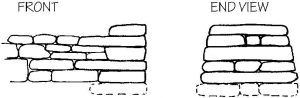
Slopes
Build in horizontal courses. Grade the courses and then that the biggest stones are most the hillside, but go along the class every bit level as possible. Start from the bottom and work uphill.

Gapping
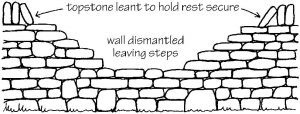
Remove and sort all the unstable stones and so that you have a firm base to piece of work from. Sort the coping stones out first.
Step the ends of the gap so that yous can tie in the new wall.
Await at the erstwhile wall to see how it was congenital and try to recreate its way. Use the old stone for rebuilding – don't clean off erstwhile moss and vegetation and ensure any additional stone used is of the same type equally the original.
Season
More often than not spring and summer because it is difficult to stay warm in walling in cold weather.
Preparation and working with groups
Site visit
Visit the piece of work site in advance to gain a clear idea of what you will be doing on the day. If working for a customer, meet with them on site to discuss the project. Assess the suitability of the projection for the grouping you lot will be leading and the time bachelor.
Consider the following questions: What resources are required for the projection and who volition supply and evangelize them? Are there whatsoever access difficulties? Consult plans or drawings to institute the location of underground services.
Undertake a risk assessment for both projection and site.
Tools & equipment
Depending on the size of the team adjust the quantity of equipment taken to site. Ensure the tools are in good condition before using them.
Here is a list of the tools and equipment you lot might need:
- First aid kit
- Appropriate protective gloves
- Touch on grade goggles
- Tape measure
- Lines and pegs
- Line and spirit level
- Fencing pliers
- Concoction frame (already made according to wall specifications)
- Walling, sledge, club and claw hammers
- Chisels (including bolster chisels)
- Garden spades
- Crowbar
- Mattocks
- Buckets
- Wheelbarrows
- Bowsaws
- Site safe signs
Ensure all team members are wearing appropriate footwear and clothing and issue the specified safety equipment.
Introduce the site, the work and the reasons for doing information technology. Walk around the site explaining what work will be undertaken. Identify potential hazards and explain how to piece of work safely around them.
Demonstrate tool use
Demonstrate and explain the prophylactic use, carrying and on-site care of the tools before starting work. Refer to the TCV Mitt Tools booklet [available presently].
Demonstrate work techniques
Demonstrate all new work techniques as you come to them. This will save mistakes and avert accidents.
Plan the movement of rock to avoid lifting and to use whellbarrows where possible.
Demonstrate the correct lifting technique (bending the articulatio genus and keeping the back direct then that the leg muscles are used and the back is not strained).
Organisation of team
Talk virtually how a wall is built, show everyone an existing piece of wall, point out the details of construction and identify and describe the regional style.
Divide the team into pairs, teaming beginners with experienced wallers. Allocate and marker a two to 3 metre section of wall per pair, 1 person on either side. A group of 12 should be able to build around 4 to six metres of wall per day.
Leave some people complimentary to collect 'new' rock from surrounding site and ensure that the different types of stones are evenly distributed.
Stress the basic rules:
- Each rock should rest on two others and two should residue on it.
- Where possible put the longest length of rock into the wall.
- Keep the courses level and build upward both sides at the aforementioned charge per unit.
- Continue to the correct batter.
- Grade the wall – largest stones at the bottom, smallest at the top.
- Never hammer on the wall.
- Pace back at regular intervals to run across what the wall looks like.
- Ever aim to cover any joints.
- The leader should check, assist and encourage people and ensure piece of work standards are maintained.
Learn the fine art of dry stone walling, woodland direction, tree planting, hedgelaying and much more.
Get instant access to the definitive 'how to' practical conservation guides. Communication, instructions and back up to manage your countryside and dark-green spaces.
Sign upwards at present
Source: https://www.conservationhandbooks.com/build-repair-dry-stone-wall/
0 Response to "How To Repair Old Stone Walls"
Post a Comment